
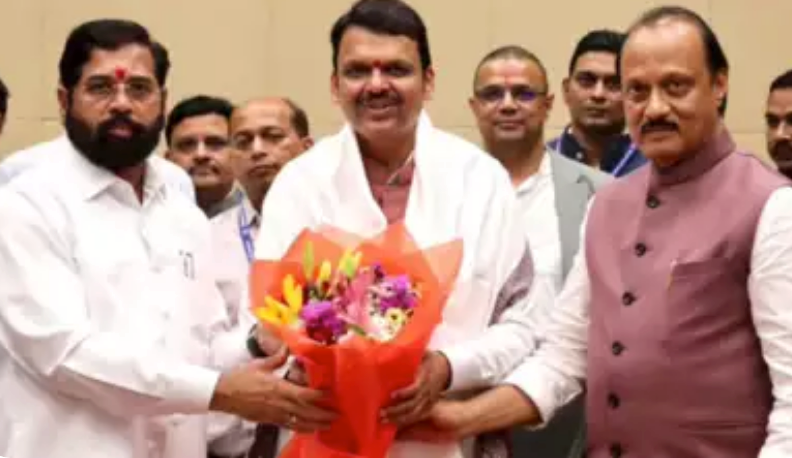
New Delhi: The Mahayuti 2.0 government has officially taken charge in Maharashtra, with BJP’s Devendra Fadnavis reinstated as Chief Minister, and Shiv Sena leader Eknath Shinde and NCP’s Ajit Pawar assuming positions as Deputy Chief Ministers. The swearing-in ceremony, held in Mumbai, was a glittering affair graced by the presence of Prime Minister Narendra Modi, marking the culmination of a 12-day political saga that followed the coalition’s sweeping mandate in the state assembly elections.
Despite securing a dominant 230 seats in the 288-member assembly, the road to government formation was far from smooth. Tensions surfaced immediately after the November 23 election results, as outgoing Chief Minister Shinde launched a determined campaign to retain his position at the helm.
Shiv Sena, which won 57 seats compared to the BJP’s record 132, argued strongly for Shinde’s continuation as Chief Minister. The party orchestrated a high-profile campaign featuring posters and slogans, tweaking Prime Minister Modi’s tagline “Ek hain to safe hain” into “Ek(nath) hain to safe hain.” Sena leaders also cited the “Bihar model,” where Nitish Kumar retained the Chief Minister’s post despite his party being the junior partner to BJP, as justification for Shinde’s claim to the top job.
The lobbying and negotiations tested the coalition’s unity, but the final agreement placed Fadnavis at the helm, supported by Shinde and Pawar as deputies. With the political dust settled, the Mahayuti government now faces the challenge of delivering on its promises to the people of Maharashtra while navigating its internal dynamics.
This latest chapter in Maharashtra’s political history highlights the complexities of coalition politics, even in the face of a decisive electoral mandate.
