
Table of Contents
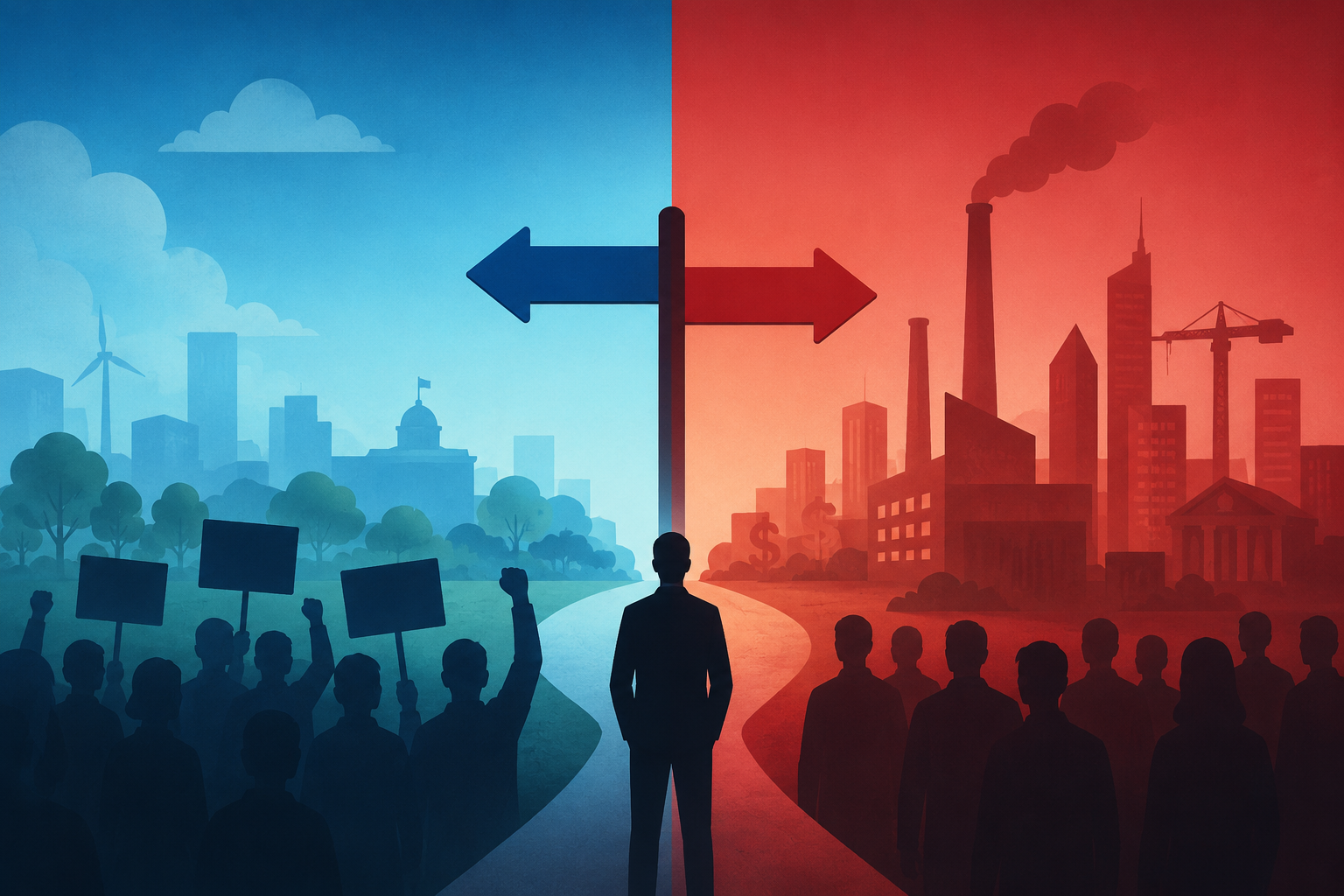
Political ideologies shape how governments make decisions on the economy, society, governance, and individual rights. Among the most widely discussed political spectrums are the left wing and the right wing. While these terms are commonly used in political debates, their meanings vary across countries and evolve over time.
Rather than representing fixed positions, the left-right spectrum serves as a framework for understanding different approaches to governance and public policy.
Origin of the Terms
The terms “left” and “right” originated during the French Revolution (1789). Members of the French National Assembly who supported significant political and social change sat on the left side of the chamber, while those who favored preserving traditional institutions sat on the right. Over time, these seating arrangements became symbolic of broader political philosophies.
Left-Wing Ideology
Left-wing ideologies generally emphasize social equality, economic redistribution, and a greater role for the government in addressing social and economic disparities.
Common principles include:
- Reducing income and wealth inequality.
- Expanding public services such as healthcare and education.
- Supporting workers’ rights and labor protections.
- Progressive taxation to fund welfare programs.
- Government intervention to regulate markets when necessary.
- Protection of minority rights and social inclusion.
Left-wing politics encompasses a wide range of perspectives, from social democracy to democratic socialism, each differing in the extent of government involvement they advocate.
Right-Wing Ideology
Right-wing ideologies generally emphasize individual responsibility, economic freedom, private enterprise, and the preservation of established institutions and traditions.
Common principles include:
- Lower taxes and reduced government spending.
- Free-market economic policies.
- Protection of private property rights.
- Limited government intervention in business.
- Emphasis on national identity and security.
- Preservation of cultural, religious, or traditional values.
Right-wing thought also includes a broad spectrum, ranging from moderate conservatism to more libertarian or nationalist viewpoints.
Comparing the Two
| Issue | Left Wing | Right Wing |
|---|---|---|
| Economic Policy | Greater government role in the economy | Greater reliance on free markets |
| Taxation | Progressive taxation | Lower taxes and reduced government spending |
| Welfare | Expanded social welfare programs | Limited welfare with emphasis on self-reliance |
| Healthcare | Public or universal healthcare often favored | Greater role for private healthcare providers |
| Regulation | More government regulation | Less regulation to encourage business growth |
| Social Issues | Often supports progressive social reforms | Often emphasizes traditional values |
| Environment | Strong environmental regulation | Balancing environmental goals with economic growth |
| Individual vs Collective | Greater emphasis on collective welfare | Greater emphasis on individual liberty and responsibility |
These are broad tendencies rather than universal positions. Political parties often combine ideas from both sides depending on national priorities.
The Political Centre
Many political parties and leaders identify with the centre or centre-left/centre-right, adopting policies from both traditions. For example, a government may support free markets while maintaining public healthcare or promote economic growth alongside social welfare initiatives.
This mixed approach is common in modern democracies.
Political Ideologies in India
India’s political landscape does not fit neatly into the traditional left-right model used in many Western countries. Political parties often combine economic, social, cultural, and regional priorities.
For example:
- Some parties support market-oriented economic reforms while also implementing extensive welfare schemes.
- Others advocate stronger labor protections and public sector investment.
- Cultural identity, federalism, caste, religion, regional interests, and social justice also influence political positions beyond the conventional left-right spectrum.
As a result, Indian politics is often described as multi-dimensional rather than purely left or right.
Strengths and Criticisms
Both ideologies have supporters and critics.
Supporters of left-wing policies argue they promote social justice, reduce inequality, and ensure access to essential public services. Critics contend that excessive government intervention can reduce economic efficiency, increase bureaucracy, and place pressure on public finances.
Supporters of right-wing policies argue they encourage entrepreneurship, economic growth, innovation, and individual freedom. Critics argue that reduced regulation and limited welfare may widen economic inequality and provide less support for vulnerable populations.
These debates continue to shape policy discussions in democracies around the world.
Conclusion
Left-wing and right-wing ideologies represent different approaches to balancing freedom, equality, economic development, and the role of government. Neither ideology is universally applicable, and most democratic societies incorporate elements of both to address changing social and economic needs.
Understanding these perspectives enables citizens to evaluate public policies more critically and engage in informed democratic debate. Ultimately, political ideologies are tools for interpreting governance rather than rigid frameworks, and their practical implementation often reflects the unique historical, cultural, and economic context of each country.
